nedtelling | counter | timer Verktøy!
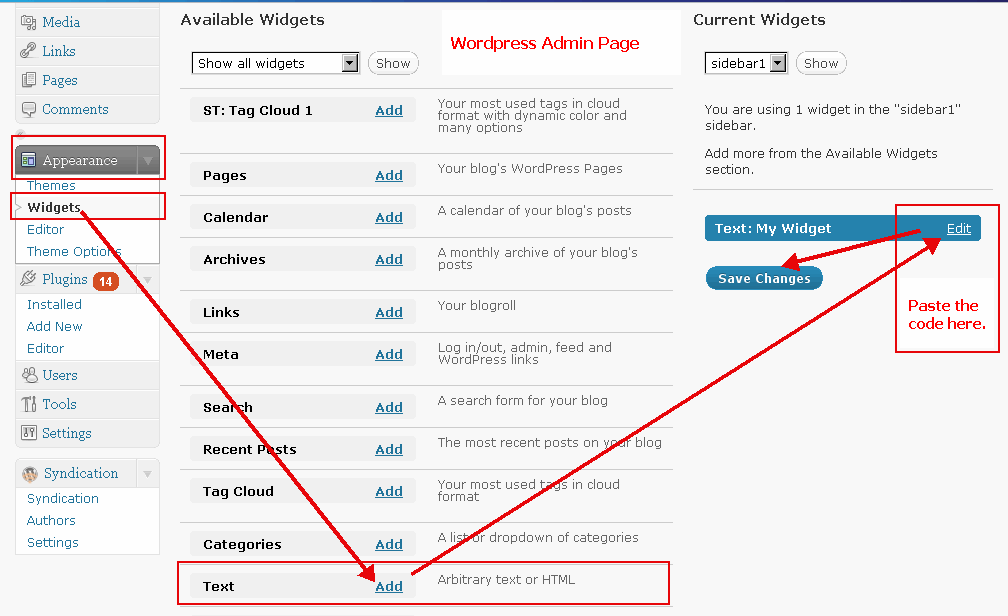
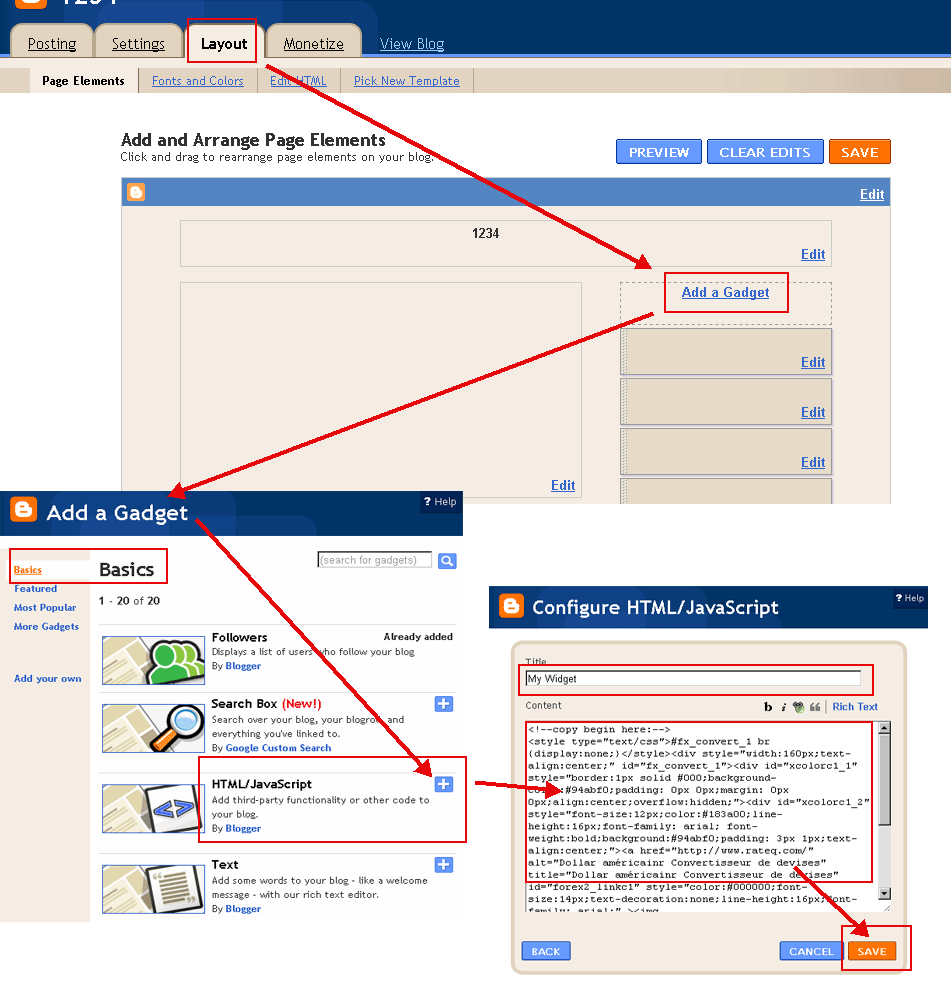
Trykk på knappen kopiere og lime inn i din blogg eller nettside.
(Du kan bytte til HTML-modus når du legger inn i bloggen din. Eksempler: WordPress Eksempel, Blogger Eksempel)
perplexity. ai 用于科研体验如何? - 知乎 Perplexity的多模型切换是亮点,同一个问题可以对比不同AI的回答。 如果你是重度用户,需要顶级模型和学术搜索,那Pro值得试试。 说在最后 AI工具更新太快,能白嫖就白嫖。 但请记住:天下没有免费的午餐,所有免费背后都有成本。
Perplexity AI - 知乎 Perplexity AI 是一款结合大型语言模型和搜索引擎技术的人工智能搜索引擎,旨在为用户提供全面且准确的搜索结果。
intuition - What is perplexity? - Cross Validated I came across term perplexity which refers to the log-averaged inverse probability on unseen data Wikipedia article on perplexity does not give an intuitive meaning for the same This perplexity
autoencoders - Codebook Perplexity in VQ-VAE - Cross Validated For example, lower perplexity indicates a better language model in general cases The questions are (1) What exactly are we measuring when we calculate the codebook perplexity in VQ models? (2) Why would we want to have large codebook perplexity? What is the ideal perplexity for VQ models? Sorry if my questions are unclear
Perplexity for different n-gram models - Cross Validated The only way to know whether increasing n reduces perplexity is by already knowing how exactly how the text was generated In practice, unigram models tend to underfit on non-trivial text datasets 10-gram models trained on small datasets tend to overfit It's difficult and not really useful to hypothesize about 2,3,4-gram models
latent dirichlet alloc - LDA perplexity with train-test split leads to . . . However, when I split the data using KFold cross-validation, train the LDA model only on the training set, and compute perplexity on the held-out test set, the curve becomes strictly increasing with the number of topics — i e , the lowest perplexity is always with just 1 topic, which obviously defeats the purpose of topic modeling
How to determine parameters for t-SNE for reducing dimensions? I will cite the FAQ from First for perplexity: How should I set the perplexity in t-SNE? The performance of t-SNE is fairly robust under different settings of the perplexity The most appropriate value depends on the density of your data Loosely speaking, one could say that a larger denser dataset requires a larger perplexity Typical values for the perplexity range between 5 and 50 For